

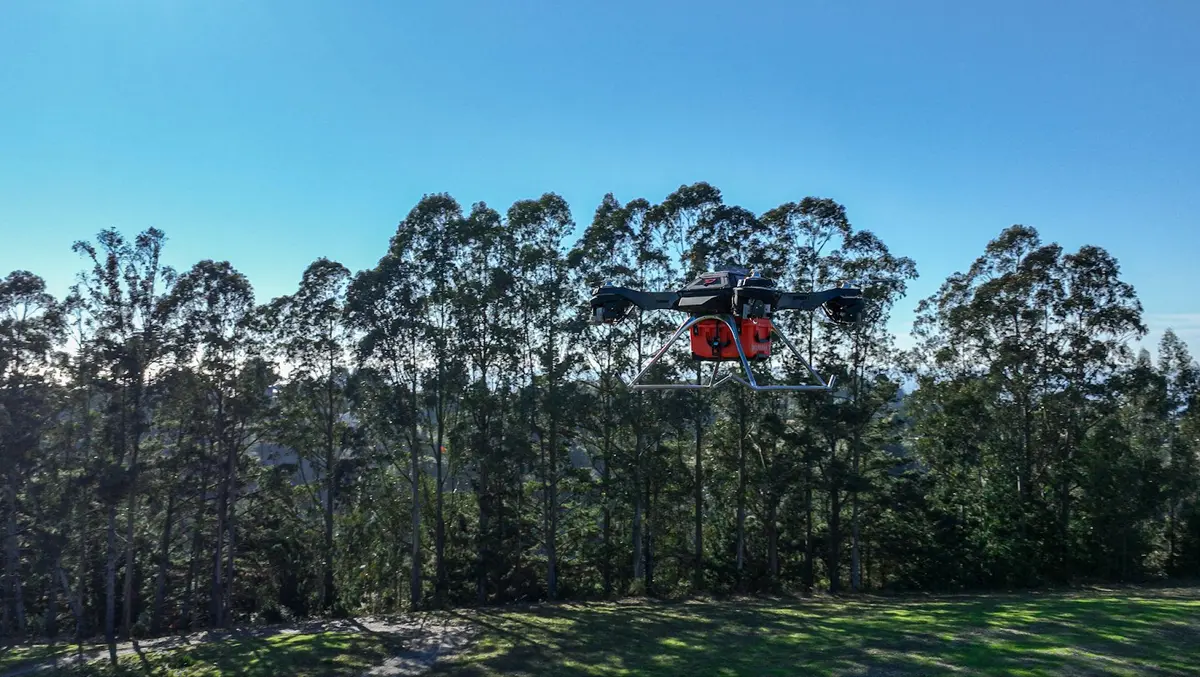
Drone Forge to distribute Parallel Flight's Firefly in APAC
Wed, 14th Oct 2026 (Yesterday)
Parallel Flight Technologies has appointed Drone Forge as distributor for its Firefly drone in Australia and the Asia-Pacific region, giving the Australian company responsibility for regional sales and customer integration.
Drone Forge will also manage in-region operations for the hybrid heavy-lift aircraft, with plans to add service, maintenance and training over time.
The arrangement expands Parallel Flight's presence in Asia-Pacific through a local partner, with an initial focus on Australia and its territories. Demand has been rising in sectors including mining, maritime operations, critical infrastructure and bushfire management, the companies said.
Firefly is a hybrid unmanned aerial system designed for heavy-lift work. Parallel Flight says the aircraft can carry payloads of up to 45kg and remain airborne for up to 10 times longer than all-electric drones.
It is designed to be transported by two people and to fit in the back of a ute. The company says it is aimed at industrial and defence-related tasks, and can provide up to 2 kW of continuous in-flight power to payloads.
Regional push
The distribution deal marks another step in Drone Forge's effort to broaden the systems it offers across air, land and maritime operations. The Perth-based integrator describes itself as platform agnostic and works with government, defence and critical infrastructure customers.
For Parallel Flight, the move creates a regional route to market for a platform developed in the United States. Firefly is produced in the US and complies with NDAA requirements, according to the company.
Craig Stevens, Chief Executive Officer of Parallel Flight, said the company had seen demand from the region. "Expanding into the APAC region with a trusted partner like Drone Forge is an important step in our go-to-market strategy," Stevens said. "We're seeing strong inbound interest from this region, and Drone Forge brings the local expertise and operational capability needed to support customers effectively. Together, we're excited to bring Firefly's unique capabilities to a new and growing market."
The agreement reflects a broader push by drone manufacturers to work through local integrators as customers seek aircraft that can stay aloft longer and carry heavier equipment. In markets such as mining, utilities and emergency response, operators often need systems that can cover large areas without frequent returns for battery changes.
Hybrid aircraft have drawn interest because they combine electric flight systems with fuel-based onboard generation, extending mission times beyond those of battery-only models. That has particular relevance in Australia and parts of the wider region, where long distances and remote operating environments shape the economics of aerial inspection, surveillance and logistics.
Use cases
Parallel Flight says Firefly is suited to work including wildland fire management, maritime operations and industrial missions. It also describes the aircraft as a Group 3 unmanned aerial system.
Drone Forge says the aircraft's flight profile could suit customers that need longer sorties with heavier payloads than are typically available from electric systems alone. Those tasks can include carrying sensors, communications equipment or specialist mission payloads into remote areas.
Tom Symes, Chief Executive Officer of Drone Forge, said the system addressed limits faced by electric aircraft. "We're excited to introduce Firefly to customers across Australia and the broader APAC region," Symes said. "Its hybrid propulsion architecture unlocks the extended range and endurance operators have been waiting for-capabilities that simply aren't achievable with traditional electric systems. This translates into longer missions, fewer interruptions, and a clear operational advantage for customers in the field."
Parallel Flight says Firefly's propulsion system is covered by five patents and that the platform has received support from US agencies including ONR, DIU, USDA, NASA and NSF.
The company describes the aircraft as an "autonomous pick-up truck in the sky".